NEW YORK WORLD'S FAIR
1939-1940
NEW YORK, NY
Purpose: To commemorate 150th anniversary of Inauguration of George Washington as our First President by "presenting a...comprehensive picture of the epochal achievements of a century and a half of modern civilization..." and to "show the way toward improvement of all factors contributing to human welfare."
Organization: Our largest exposition ever. Preliminary Committee of 6 appointed June 1935. Exposition Co. chartered Oct. 1935, capital $42,000,000; public subscription to stock. City granted $26,500,000; state over $6,000,000 and Congress $3,000,000.
Site: Over 1,200 acres, 3 1/2 miles by 1 1/2 miles at widest, Flushing Meadows, Long Island; previously used as city dump; now mostly built over but portion is a park. This site also hosted the 1964 New York World's Fair.
Dates, Attendance: First year, April 30 to Oct. 31, 1939; second year, May 11 to Oct. 27, 1940. Total attendance, both years, over 45,000,000 paid.
Participants: All states and territories and 63 foreign countries, latter number the largest ever. Dozens of both erected own buildings. Exhibits exceeded 50,000; many Federal displays but no Mint Exhibit.
Comment: Architecture was modern in character reflecting "individual freedom of thought of those creating it." From this great exposition, and from 1933 Century of Progress Exposition, Chicago, came "cleanness of line, simplicity and color consciousness" carried over later into shops, interiors and industry. Grounds were so designed that important plaza at each entrance led to Fair's dominant feature, Theme Center or famous Trylon and Perisphere.
Latter was true sphere, 180 ft. in diameter, 18 stories high. It housed Theme Exhibit or "Garden City of Tomorrow," largest model city ever built; flanked by Trylon, 700 ft. triangular obelisk. Exposition was divided into zones--each a significant phase of modern life, e.g., Government, Transportation, Communication, Shelter, Clothing, Food, etc. Railroad exhibit was largest on grounds and there was privately sponsored numismatic exhibit.
Medals: Both Official Tokens and Official Medals were issued. Latter designed by Julio Kilenyi, struck by Robbins Co. Sizes, 1 1/4 in. bronze & brass; 2 1/4 in. and 3 in. bronze only, preclude listing here. Token was medal and not trade token; actually, it became known as World's Fair Dollar, per below; all latter dated 1939, no 1940 issue.
WORLD'S FAIR DOLLAR
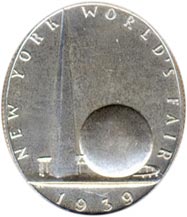
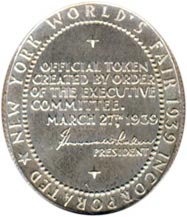
Designed by H. C. Kreis, struck by Medallic Art Co. and sold by Manufacturers Trust Co. at its Exposition branch beginning June 23, 1939. Dubbed World's Fair Dollar probably because it cost $1, was silver with reeded edge and length was about equal to diameter of silver dollar. Originally intended to be round, but changed to elliptical at last minute to comply with slug laws promulgated by the vending machine industry. It is .900 fine, containing 59.06% of silver content of silver dollar.
Photos courtesy of John Dean
Obv. Trylon and Perisphere; around New York World's Fair; below 1939
Rev. In field, within beaded oval, + / Official Token / Created by Order / of the Executive / Committee. / March 27th, 1939 / (signed) Grover W. Whalen / President / +; outside, around *New York World's Fair 1939 Incorporated
HK-491 Silver, reeded edge. Oval, 35mm x 30mm.
PALLADIUM DOLLAR
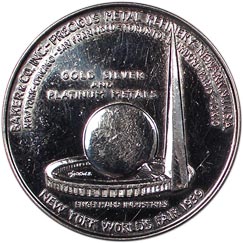
Issued privately by Baker & Co. Inc., later Baker Platinum Division of Engelhard Industries, Inc., "world's largest refiners and fabricators of precious metals", now part of BASF Corporation. Four (4) sizes-- 1/2, 1, 5 and 10 oz.--sold at Baker's booth at Fair for $24 per oz., metal's retail value then (vs. $300 per oz. in 2006.) Only 1 oz. size qualifies for listing here.
Discovered 1803 by British scientist W. H. Wollaston and named from Pallas Athena, Goddess of Wisdom, Good Fortune and Health, palladium is one of 6 precious metals of platinum group; used widely in electrical contacts, in jewelry and as catalyst. On basis of world production, palladium is slightly rarer than platinum which, in turn, is 14 times as rare as gold.
Baker states its "records...have been destroyed and all of the people...involved...have passed away"; that "most of those (medals) sold were returned eventually" for refund and later were melted down. No more 1 oz. pieces are in stock and dies have been destroyed. All medals were dated 1939, no 1940 issue.

Photos courtesy of Jonathan Brecher
Obv. Perisphere and Trylon, with circular ramp; within ramp microscopic (c) N.Y.W.F.; above Perisphere Gold Silver / and / Platinum Metals; above all around, in two lines, Baker & Co., Inc.--Precious Metal Refinery--Newark, N. J. U. S. A. / New York--Chicago--San Francisco--Toronto--London--Paris--Tokyo; below all Engelhard Industries / New York World's Fair 1939
Rev. Statue, to l. Pallas, to r. Athena; above, around • This Charm is Genuine Palladium •; below, around Goddess of Wisdom • Bestower of Good Fortune • Guardian of Health.
HK-492 Palladium. 38mm.
In original presentation case*.
* Black leatherette jeweler's box, approx. 2 1/2 in. sq., white satin and black velvet lined; on top, across center Palladium, to lower r. Baker & Co., Inc / Newark, N. J.
LINCOLN GOLD DOLLAR
Issued expressly for exposition by late Thomas L. Elder, New York City coin dealer (see Part III for Elder biographical sketch); struck by Medallic Art Co. Of the 500 issued, 100 were struck with matte surface; all medals were dated 1939, no 1940 issue.


Photos courtesy of John Dean
Obv. Male bust facing l.; to l., around Abraham; to r., around Lincoln; below bust 1939.
Rev. Circle of 9 stars around A / Token--all within open wreath tied at bottom with ribbon; another star in open space at top between wreath tips.
HK-493 Gold, size of Gold Dollar. 15mm. 1.75 grams. Specific gravity: 13.0. Matte proof. Only 100 struck. DeLorey 49.
HK-493a Gold. 1.75 grams. Specific gravity: 13.0. Brilliant finish. Only 400 struck. DeLorey 49.
HK-493b Silver. DeLorey 49. Only 25 struck.
HK-493c Gold-plated Copper. 1.25 grams. Specific gravity: 9.0. Only 26 struck. DeLorey 49.
HK-493d Silver-plated Brass. DeLorey 49.
HK-493e Brass. DeLorey 49.
NORTH CAROLINA DOLLAR
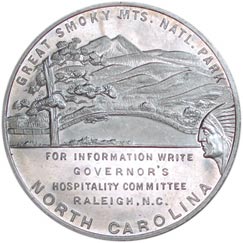
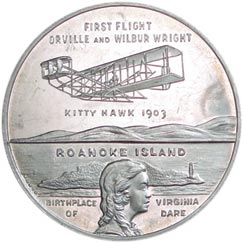
Distributed as advertising piece by North Carolina Department of Conservation and Development at North Carolina exhibit at Exposition. Issue limited to 25,000 pieces donated by Aluminum Co. of America (now Alcoa, Inc.), which has plant located in state.
Photos courtesy of Jonathan Brecher
Obv. In upper half are mountains with auto parked in observation area at base; above Great Smoky Mts. Natl. Park; in lower half For Information Write / Governor's / Hospitality Committee / Raleigh, N. C. / North Carolina; at r. border is Indian head in profile.
Rev. In upper half is replica of first airplane; above First Flight / Orville and Wilbur Wright; below plane Kitty Hawk 1903; in lower half is female bust facing r. with island in background; above Roanoke Island; to l. of bust Birthplace / of, to r. of bust Virginia / Dare; to l. border, microscopic W. & H. Co.
HK-494 Aluminum. 38mm.
HK-478 to HK-490a HK-495