HEENAN-SAYERS BOXING BOUT
1860
WORLD'S HEAVYWEIGHT CHAMPIONSHIP
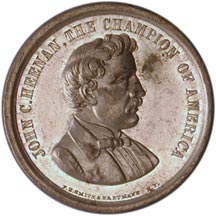
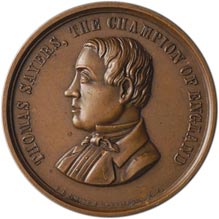
These medals commemorate one of famous bare-knuckle heavyweight championship bouts. John C. Heenan, born Troy, NY, moved to California; called Benicia Boy, won first clear claim to American title. He journeyed to England, there met world champion Tom Sayers. Latter born Brighton, England; bricklayer by trade; won championship 1857. Heenan-Sayers fought at Farnborough, April 17; called "most famous" in English prize ring history; lasted over 2 hours; ended in 42-round "draw" when crowd swarmed ring following injury to Sayers' arm. Latter then retired permanently from boxing.
Professional pugilism lacked all law and order until 1743 when Jack Broughton, one of early English champions, compiled set of rules; these superseded by London Prize Ring Rules of 1838; "bare-knuckles" still used. In 1866, 8th Marquis of Queensbury published Queensbury Rules calling for gloved contests. Acceptance by professionals took years or until 1892 when John L. Sullivan lost world heavyweight title to James J. Corbett at New Orleans. Since latter date, Queensbury Rules are basic in boxing.
While this contest itself was held in England, medals were struck here by Smith and Hartmann, New York City, following Heenan's return to United States.
Photos courtesy of W. David Perkins
Obv. Raised male bust facing r.; above John C. Heenan, the Champion of America; below bust, microscopic F. B. Smith & Hartmann N. Y.
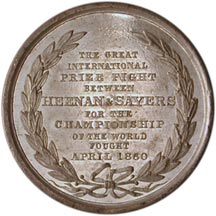
Rev. Within an open wreath The great / international / prize fight / between / Heenan & Sayers / for the / championship / of the world / fought / April 1860.
HK-9 Copper. 34mm.
HK-10 White Metal.
Photos courtesy of Fred Holabird
Obv. Raised male bust facing l.; above Thomas S. Sayers, the Champion of England; below bust, microscopic F. B. Smith & Hartmann N.Y.
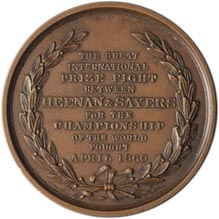
Rev. Within an open wreath The great / international / prize fight / between / Heenan & Sayers / for the / championship / of the world / fought / April 1860.
HK-10a White Metal. 34mm.
HK-10b Copper.