COTTON STATES AND INTERNATIONAL EXPOSITION
1895
ATLANTA, GA
Purpose: To exhibit "resources and possibilities of the Cotton States"; to emphasize revival of cotton industry following Civil War; "to stimulate trade with Spanish-American countries" and to show an Atlanta which had "risen from its fires and ashes" of 1864.
Organization: W. A. Hemphill, founder of Atlanta Constitution, originated idea; planning committee formed Dec. 28, 1893; $200,000 guarantee fund raised. Exposition company chartered 1894; public subscription to stock. Commissioners sent to most important foreign powers to create interest, preceded by formal letters of invitation from Exposition Co. directed through U.S. Department of State. Governor extended broad domestic invitations. City and state made substantial grants; Congress only $200,000.
Site, Dates, Attendance: Piedmont Park, Atlanta. Held Sept. 18 to Dec. 31, 1895; attendance almost 800,000.
Participants: Thirty-six states and 22 foreign countries represented; most southern states, California, Illinois, Massachusetts, New York, Pennsylvania and Costa Rica erecting own buildings. Many Federal displays but no Mint Exhibit.
Comment: Large Central Plaza with great curving terraces, surrounded by exhibition Palaces, gave impression of amphitheater; lake mirrored huge wood-frame gray and white buildings, mostly of Romanesque motif. Victor Herbert's "Salute to Atlanta" written for opening day ceremony; President Grover Cleveland pressed button in Gray Gables, MA, setting exposition wheels in motion. Considerable prominence given Negro exhibit for first time in U.S. exposition history; "a sociological study, an ethnological fact" marking progress of colored population "...in intelligence, industry and enterprise..." Booker T. Washington was one of opening day speakers. Along with cotton, exposition emphasized agriculture, coal mining, fertilizers, iron and lumber. Liberty Bell, most popular exposition item of that period, brought from Philadelphia for "Liberty Bell Day," Oct. 9. At close, entire enterprise showed only modest $25,000 loss, excellent result of its kind.
OFFICIAL MEDAL
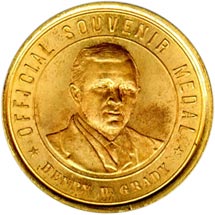
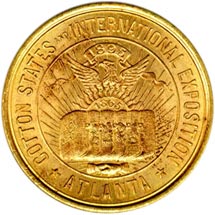
Designed and struck at U.S. Mint, Philadelphia. On obverse, rays of fire under bole of cotton represent desolation of crops resultant from Sherman's march to sea. Phoenix rising from flames is symbolic of resurrection of industry. Henry W. Grady, on reverse, was editor of Atlanta Constitution; his writings and speeches helped reunite people of North and South after Civil War.
Photos courtesy of John Dean
Obv. Within circle a bale of cotton; on l. end K / 124; above, 1865; above that, phoenix rising from flames; above phoenix (on ribbon) 1895; below bale, clasped hands; outside, around Cotton States and International Exposition; below * Atlanta *
Rev. Bust, within circle; outside, around Official Souvenir Medal; below * Henry W. Grady *
HK-268 Gilt Bronze. 35mm.
EXPOSITION PALACE DOLLARS
Photos courtesy of Jonathan Brecher
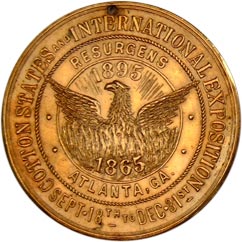
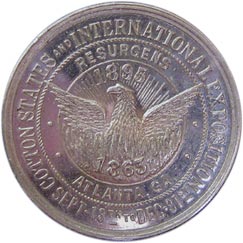
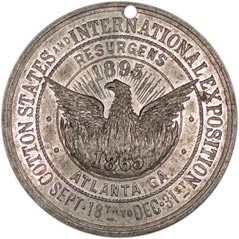
Obv. In center, phoenix, wings outstretched, rises from flames; rays and 1895 above, 1865 in flames below; microscopic Childs below l. and Chi below r. of date--all within circle; within outer rope-like circle and inner circle, at top Resurgens, at bottom Atlanta, Ga., two dots on each side between; wing tips of phoenix extend through second circle; border legend Cotton States and International Exposition Sept 18th to Dec. 31st
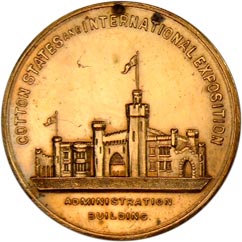
Rev. Edifice; below Administration / Building; above, around Cotton States and International Exposition
HK-269 Aluminum. 38mm.
HK-269a Brass.
Photos courtesy of Robert Fowler
Obv. Same as obverse of No. 269 [Phoenix].
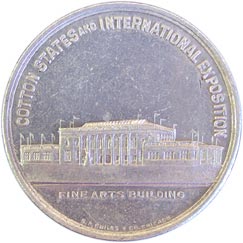
Rev. Edifice; below Fine Arts Building; above, around Cotton States and International Exposition; at bottom border, microscopic S. D. Childs & Co. Chicago
HK-270 Brass. 38mm.
HK-270a Aluminum.
Photos courtesy of Jonathan Brecher
Obv. Same as obverse of No. 269 [Phoenix].
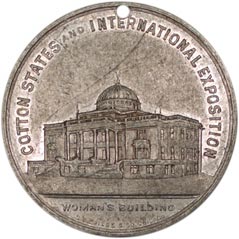
Rev. Edifice; below Woman's Building; above, around Cotton States and International Exposition; at bottom border, microscopic S. D. Childs & Co. Chicago
HK-271 Aluminum. 38mm.
HK-271a Brass.