CALIFORNIA STATEHOOD CENTENNIAL
1950
Purpose: To celebrate 100th anniversary of Statehood.
Organization: Original planning provided also for celebrations of Gold Discovery and Gold Rush Centennials--1948 and 1949 respectively; listed separately, Part I. State Chamber of Commerce most active throughout; county and city committees organized representing all interests. Legislature created Centennials Commission September, 1947; granted $2,000,000 for 3-year program; coordinated by state Director of Finance. Local committees permitted to draw upon state grant to meet partial costs of their own observances.
Site, Dates: Statewide, throughout 1950; actually this was continuation of 1948 and 1949 festivities.
Comment: California's admission to Statehood, Sept. 9, 1850, two years after discovery of gold and without probationary period as territory, was unique among states. Statehood centennial highlights included week-long San Francisco festival, climaxed Sept. 9 by Admission Day ceremonies sponsored by Native Sons and Daughters of Golden West; Sacramento's 11-day annual State Fair emphasized centennial, Governor cutting 650-pound birthday cake on Admission Day. Los Angeles area presented pageant, "The California Story," in Hollywood Bowl; San Diego's Fiesta stressed Spanish founding of state.
Permanent commemorative plaques placed statewide during all three years; film, "California's Golden Beginnings" shown everywhere; Centennials Caravan, traveling museum, toured state. Reenactment at San Jose, Dec. 15-17, of Inauguration of First Governor and pageant, "So Dawned a State," sponsored by Centennials Commission and local Chamber of Commerce, termed "climax" of 3-year celebration. (For additional information on Native Sons of the Golden West, see Part I, U.S.S. California Launching--1904).
Medals: First issue below was Official Medal, sponsored by state Chamber of Commerce Centennials Committee after unsuccessful efforts to have U.S. commemorative half dollar struck; issued by California Medalists Society, trade name of Jack Hecht, San Francisco committee member, and his associates. Latter also issued 1948 and 1949 medals. Struck by Irvine & Jachens, Daly City, CA; obverse die said cut by Fred Johnson; reverse die same as Type I octagonal dollar of 1915 Panama Pacific International Exposition. Issue limited to 3,000 Bronze pieces, 1,000 being 24K Gold-plated; sold for $1 and $2.50, respectively.
OFFICIAL MEDAL
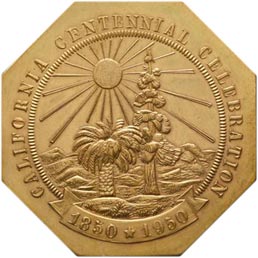
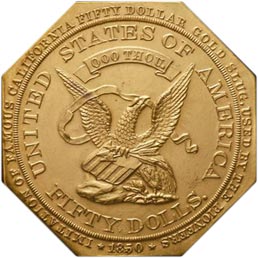
Photos courtesy of Fred Holabird
Obv. Within beaded circle, landscape scene with two trees (palm and redwood) in foreground, setting sun and rays above; legend around, California Centennial Celebration; on ribbon on bottom border, 1850 * 1950
Rev. Same as reverse of No. 423 [$50 slug].
HK-503 Bronze. Octagonal. 40mm x 40mm.
HK-504 Bronze, gold-plated.
UNIFACE DOLLAR
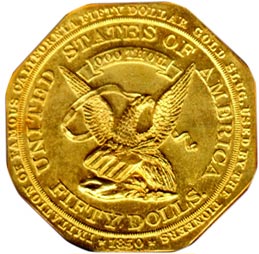
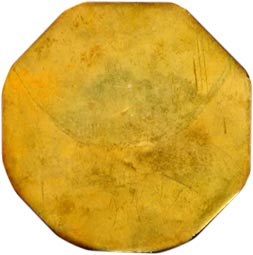
Photos courtesy of John Dean
Obv. Same as reverse of No. 423 [$50 slug]. UNIFACE.
HK-505 Bronze, gold-plated. Octagonal. 40mm x 40mm.
HK-500 to HK-502 HK-506 to HK-506b